Caesarea from Tel Aviv
Under an hour north, Herod’s harbor city keeps a working Roman theatre, a hippodrome along the surf, the stone that names Pontius Pilate — and an aqueduct striding down a free public beach.
The short version
- Caesarea sits 45–60 minutes north — the train to Caesarea–Pardes Hanna plus a short taxi, or the simpler drive — with the national park’s hours and fees at en.parks.org.il and the alarm’s midweek rule covering the Shabbat transit thinning per this network’s standing Tel Aviv logic.
- The founding facts: Herod the Great built Caesarea Maritima in roughly a decade around 22–10 BC — a planned Roman harbor city named for Augustus, whose artificial harbor (Sebastos) ranked among the largest ever built when its concrete moles closed the open coast.
- The theatre is the site’s working monument: Israel’s oldest Roman theatre, restored to host concerts and performances today — an ancient venue with a modern events calendar and the Mediterranean as its backdrop.
- The Pilate stone per the alarm: a dedicatory inscription naming Pontius Pilate, prefect of Judaea, was found reused in the theatre’s fabric in 1961 — the sole surviving physical artifact naming him; a replica stands on site with the original held by the Israel Museum.
- The hippodrome-on-the-sea and the promontory palace run the harbor quarter’s spectacle: chariot-racing stands along the surf line, mosaic floors at the water’s edge, and Crusader-era walls (Louis IX’s 13th-century fortifications) wrapping the medieval layer over the Roman one.
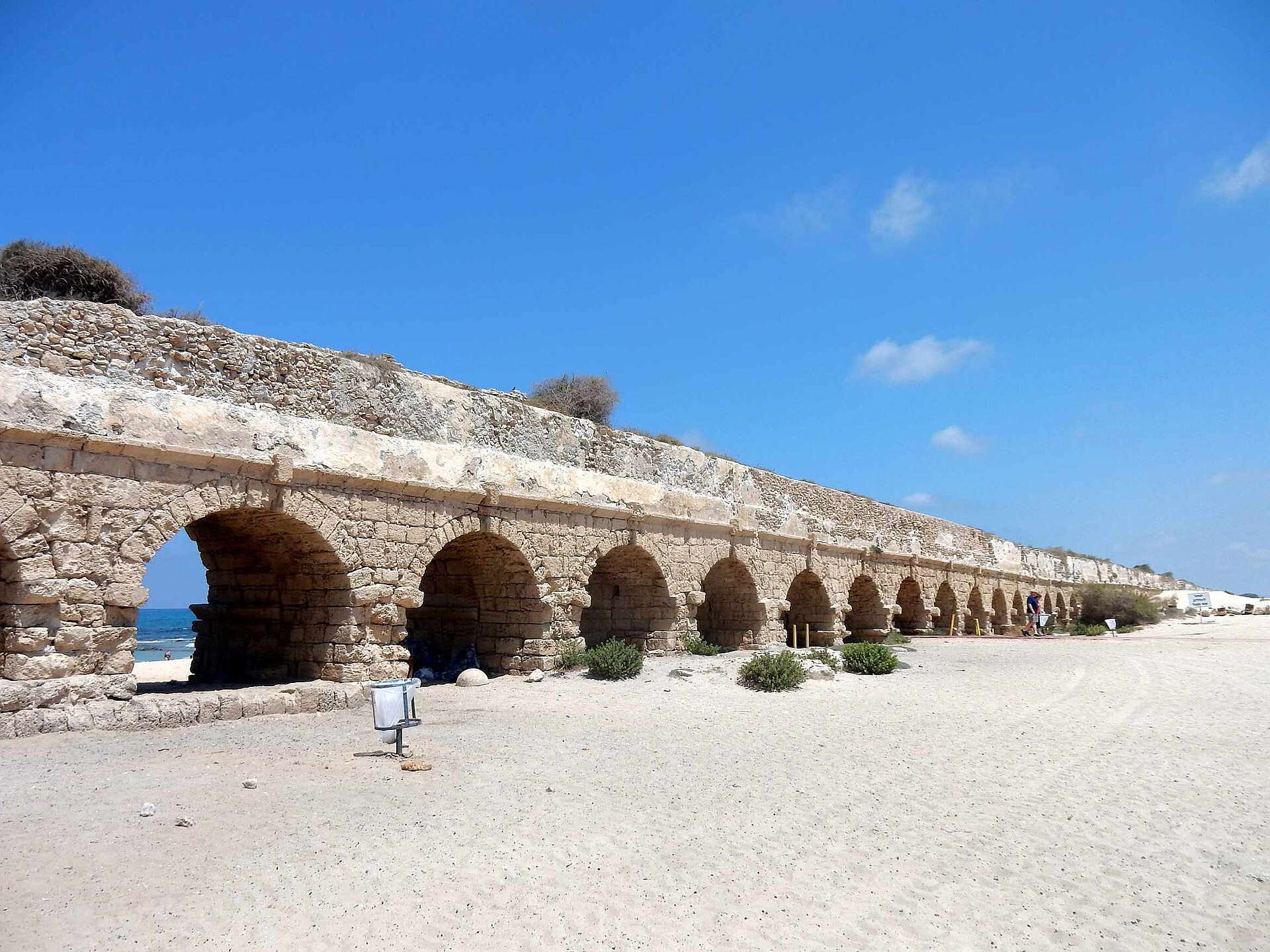
- The aqueduct beach per the alarm is the free coda: the high-level Roman aqueduct strides directly down a public beach north of the park — arches on sand, no ticket, the site’s best casual photograph — while the dive center runs booked underwater trails through the sunken harbor for certified and intro divers alike.

Getting there
The drive is the flexible answer; the rail-plus-taxi version works midweek per the alarm, with the Shabbat window (Friday afternoon through Saturday night) thinning transit to the point that the car decides those days. The national park’s entrance handles tickets and the visitor center’s harbor-history film; the aqueduct beach sits a short drive or long walk north of the gates, free at all hours. Summer visits front-load the morning — the ruins run shadeless — and concert evenings at the theatre invert the day entirely when the calendar cooperates.
The day
The theatre opens the circuit: the restored cavea, the stage against the sea, and the Pilate stone’s replica with its four legible lines doing more for the historically minded than whole museum wings — the original’s 1961 discovery, reused as a step, is the site’s best story of evidence surviving by accident. The promontory palace and hippodrome follow along the waterline: the racing stands’ surviving seats, the starting gates’ geometry, and mosaics washed by spray at the palace’s sea edge. The harbor quarter mixes the layers — Herodian moles under the water, Byzantine streets, Crusader gates and moat — with the visitor center’s film sorting the sequence. Lunch runs the harbor’s restaurants inside the old walls. The afternoon closes at the aqueduct beach per the alarm: arches marching down the sand, swimmers in their shade, and the free photograph that outperforms the ticketed ones. Divers with bookings trade the beach hour for the drowned harbor’s underwater trail — masonry and columns on the seabed where Sebastos stood.
When to go
October through May runs the ruins at walking temperature; summer works on morning discipline and beach afternoons. The theatre’s concert season (summer especially) turns evenings into the site’s second life — a booked performance under the same roofless sky Herod’s audiences knew is the connoisseur’s version. Shabbat reshapes transit and crowds per the alarm’s midweek rule: the park itself operates, but the getting-there math changes. Winter storms occasionally close the harbor quarter’s sea-edge paths and reliably produce the aqueduct’s moodiest photographs.
Frequently Asked Questions
What makes the Pilate stone such a big deal?
It’s the only physical artifact naming Pontius Pilate — a dedication inscribed during his own tenure, found in 1961 reused as a theatre step. For a figure otherwise known from texts, one stone with his name and title settles historicity debates the way only archaeology can. The on-site replica marks the find; the original lives at the Israel Museum.
How impressive was the original harbor really?
Sebastos was an engineering landmark: enormous concrete moles poured with hydraulic (underwater-setting) concrete on an open, harborless coast, enclosing a basin ranked among the ancient world’s largest artificial harbors. Earthquakes and subsidence drowned it; the dive trail and the visitor center’s reconstructions carry what the surface can’t show.
Is the aqueduct beach really free?
Fully — it’s a public beach north of the national park with the Roman aqueduct running down it, no ticket, no gate. Swimming, shade under the arches, and the site’s most repeated photograph all cost nothing. The park ticket buys the theatre, hippodrome, and harbor quarter; the beach is the bonus track.
Can beginners do the harbor dive?
The dive center runs introductory dives alongside certified-diver trails through the sunken harbor’s numbered stations — columns, anchors, and mole foundations on the seabed. Booking ahead per the alarm is the rule; sea state decides the day. Snorkel versions cover shallower sections when conditions allow.
Caesarea or Masada from Tel Aviv?
Masada (documented on this network with its Snake Path heat rules) for the desert fortress epic at the longer haul; Caesarea for Roman-harbor history under an hour away with a swim attached. Desert drama versus Mediterranean ease — and in summer, Caesarea’s sea breeze wins the argument by ten in the morning.